Blog Post 1: Being Responsible Digital Citizens
For my first blog post I want to focus on digital citizenship and reflect on how digital literacy frameworks help us think about our roles as learners in creating positive online environments. Over the past few weeks, I have found myself thinking more intentionally about my own responsibilities as a digital citizen and how my actions online can affect others. This reflection has pushed me to consider not only how I engage with spaces, but also how I can model responsible behaviour and support my peers in doing the same.
What is Digital Citizenship?
Digital citizenship is the responsible, ethical, and safe participation in digital spaces. It goes beyond knowing how to effectively use digital tools and platforms, it involves understanding the impact of our actions online, communicating with the right intent, and being mindful of both our own privacy and the privacy of others. Digital citizens must also recognize their rights and responsibilities in online environments and understand the permanence of our online behavior.
As students in an online course, it is especially important to educate ourselves about digital footprints, respectful communication, privacy management, and intellectual property. Knowing and following these guidelines will help us navigate the risks and opportunities that are ever-present in digital spaces, both academically and personally.
This Tedx Talk, Marialice Curran, who is an educator and advocate for digital citizenship, uses the story of Charlie Brown to explore what it means to be a responsible digital citizen. Drawing from the comic strip, she highlights lessons about empathy, kindness, and resilience in online spaces. She connects these values to modern digital behaviour, encouraging audiences to think before they post and treat others with respect.
Digital Literacy Framework: SIFT
In EDCI 136, we further explored digital literacy frameworks, which added to my understanding of how I engage with information online. These frameworks help us organize the skills needed to navigate online spaces as learners, including researching, creating content, evaluating sources, and participating in online communities.
One framework that stood out to me was the SIFT method, which stands for Stop, Investigate the source, Find better coverage, and Trace claims back to the original context. This method offered me a clear strategy for evaluating online information, something I do constantly as a student. In the past I have found myself relying on insignificant indicators such as professional looking websites in order to tell me if an online source was credible. Reflecting on this made me realize how easily misinformation can slip through when we do not take the time to fully evaluate our sources.
The SIFT method encourages a more critical approach, encouraging me to to slow down and think about evidence, context, and verification. I found this particularly valuable because it promotes healthy skepticism rather than immediate trust or dismissal of a source. I believe these skills are necessary as students in a digital world full of increasing misinformation.
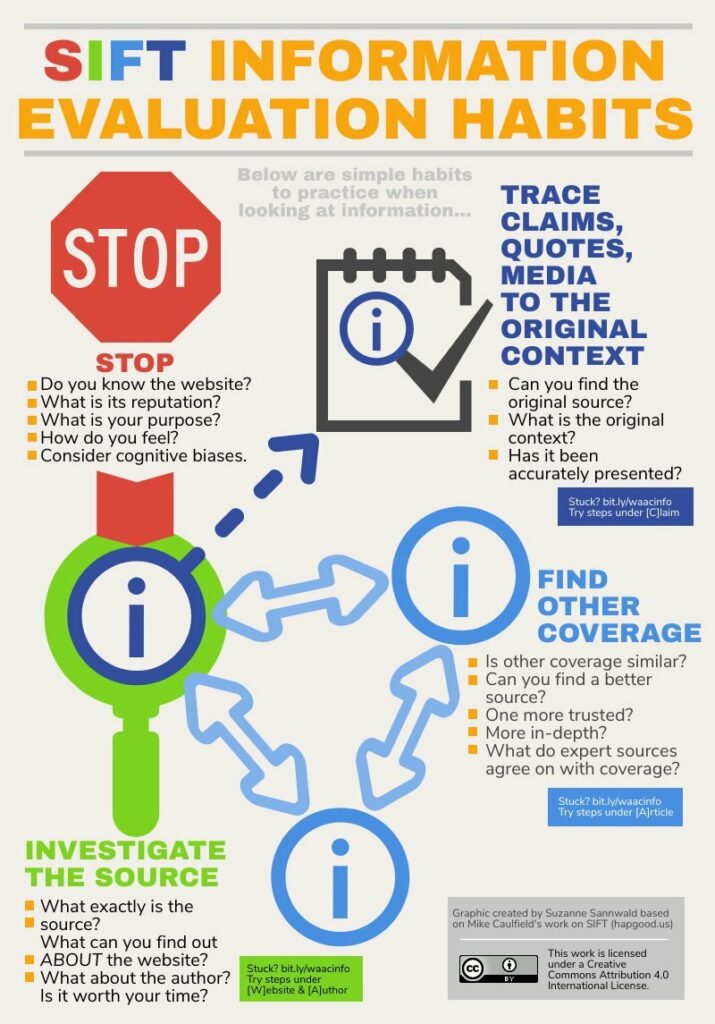
Infographic by Suzanne Sannwald is licensed under a Creative Commons Attribution 4.0 International License.
Connecting Citizenship and Literacy
Responsible participation online depends heavily on our ability to critically evaluate information. Being digitally literate means understanding what information we trust, as well as recognizing how our actions contribute to the digital environments we are a part of. These last weeks of the course have challenged me to move beyond passive online consumption and instead engage more thoughtfully with digital content.
Personally, I have been encouraged to ask better questions and reflect deeper on my own digital identity. As my assignments become increasingly research-focused, I see strategies like SIFT as essential for supporting informed decision making throughout my research process. I have learned that digital citizenship and digital literacy are closely connected, and that developing both is an ongoing responsibility I want to be more aware of and carry forward in my academic and digital life.
References
Curran, M. (TedxTalks)(2016, may 26). Lessons on digital citizenship from Charlie Brown (Video). YouTube.https://www.youtube.com/watch?v=JvDGGceA-0A
Northern Kentucky University. (2022). Evaluating with SIFT (Photo). Information Literacy. https://saalck.pressbooks.pub/infolit/chapter/evaluating-sift/